
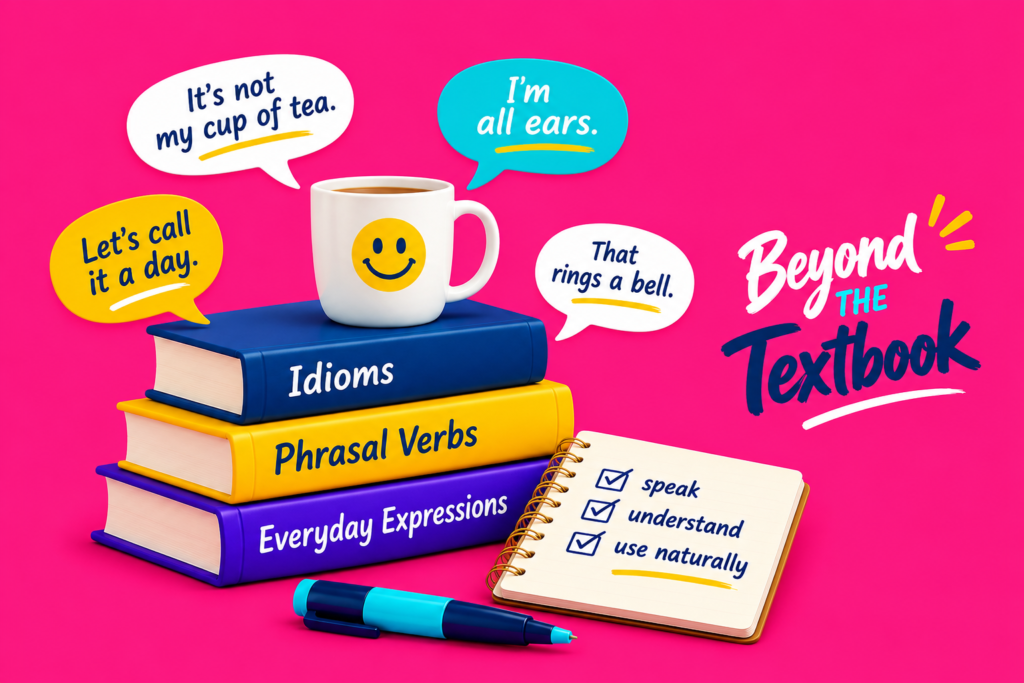
Today’s Workout
Today you will practise:
- Understanding common idioms and phrasal verbs
- Recognising expressions used in everyday conversations
- Using informal English naturally and appropriately
- Responding to familiar expressions in context
- Understanding when expressions have more than one meaning
- Speaking more confidently using everyday English
What Do They Really Mean?
Discover how everyday English expressions can have meanings that are different from their individual words.
Read these expressions and their meanings.
| Expression | Meaning | Example sentence |
| I’m all ears. | I’m listening carefully. | You said you had some exciting news. I’m all ears! |
| It’s not my cup of tea. | It’s not something I particularly enjoy. | I know many people love horror films, but they’re not my cup of tea. |
| That rings a bell. | It sounds familiar. | I think I’ve heard that name before. It rings a bell. |
| I’m on the fence. | I haven’t made a decision. | I’m on the fence about moving to another city because I enjoy my current life here. |
| It’s a piece of cake. | It’s very easy. | I thought the task would be difficult, but it was a piece of cake. |
| Let’s call it a day. | Let’s stop working for now. | We have been working on this project for hours. Let’s call it a day and continue tomorrow. |
Put It Into Conversation
Choose three expressions.
For each one, explain a situation where someone might naturally use it, then create your own sentence using the expression.
Phrasal Verbs in Action
Practise using common phrasal verbs to describe everyday activities and situations.
Read these phrasal verbs.
Run out of — have none left
Put off — delay something
Come across — find something unexpectedly
Look after — take care of someone or something
Figure out — understand or solve something
Turn down — reject an offer or request
Your Task
Same Words, Different Meanings
Explore how some phrasal verbs can have more than one meaning depending on the context.
Read these examples.
| Take off | The plane took off at seven. | She took off her jacket. |
| Pick up | I’ll pick you up at the station. | He picked up a few Spanish phrases during his holiday. |
| Work out | I work out at the gym three times a week. | Everything worked out in the end. |
Your Task
For each phrasal verb:
- Explain the meaning in both sentences.
- Identify which meaning is more familiar to you.
- Create a new sentence using one of the meanings.
Extra Challenge
Can you think of another meaning for take off, pick up or work out?
Everyday Conversation Expressions
Practise using short expressions that help conversations sound friendly, natural, and less formal.
Read these expressions.
No worries. — It’s not a problem.
Fair enough. — I understand or accept your point.
Sounds good to me. — I agree with the suggestion.
It’s up to you. — You can decide.
I see what you mean. — I understand your point.
That’s a good point. — You’ve said something worth considering.
Conversation Practice
Read the following statements and respond using an appropriate expression.
- “Sorry, I’m a few minutes late.”
- “Shall we meet at the café instead?”
- “I think the cheaper option might be more practical.”
- “Would you prefer to leave now or wait until later?”
- “I don’t enjoy crowded places because they make me uncomfortable.”
- “Perhaps we should check the information before making a decision.”
Read the Conversation
Practise understanding idioms and phrasal verbs as part of a natural conversation rather than as separate vocabulary items.
Maya: Have you figured out what you’re doing this weekend?
Daniel: Not yet. I was going to visit my cousin, but something came up.
Maya: Oh, that’s a shame. Are you going to put it off until next weekend?
Daniel: Probably. I might just stay home and catch up on a few things.
Maya: Fair enough. I’ve been meaning to sort out my wardrobe.
Daniel: That sounds productive. I came across some old photographs while cleaning yesterday.
Maya: Really? Anything interesting?
Daniel: A few from our school days. They brought back so many memories!
Explore the Language
Find the expressions that mean:
- Understand or solve something
- An unexpected situation happened
- Delay something
- Do something you haven’t had time to do
- 0rganise or tidy something
- Find something unexpectedly
- Make someone remember the past
Final Workout — Make It Sound Natural
Bring together the expressions you’ve learnt by using them naturally in a short conversation.
The Situation
Two friends are discussing their plans for the weekend.
One friend has had to change their plans because something unexpected happened.
Your Challenge
Create a short conversation between the two friends.
Include:
- one idiom
- two phrasal verbs
- one everyday conversational expression
Try to make the conversation sound natural rather than forcing expressions into every sentence.